Current Affairs


Saturday, May 3, 2014

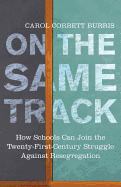
On the Same Track: How Schools Can Join the Twenty-First-Century Struggle Against Resegregation

Carol Corbett Burris (Get this book)
An educator offers a bold prescription to promote equality in America's public schools. High school principal and educational researcher Burris delivers a strong critique of tracking, the practice of sorting students within schools or districts that gives them different access to learning. Drawing on numerous studies and her own experiences and interviews, Burris concludes that tracking causes segregation of those black, Latino and poor students who are identified as low achievers with limited intellectual prospects. Well-educated and economically advantaged parents feel that they deserve educational privileges for their children. Burris offers concrete advice for school leaders trying to counter such assumptions, and she argues persuasively that tracking undermines real educational achievement for all students. An important book that should be required reading for educators, parents and school boards.--Kirkus

Saturday, April 19, 2014

The Next America: Boomers, Millennials, and the Looming Generational Showdown

Paul Taylor (Get this book)
An incisive survey of vast recent changes in American society and the ever-wider generation gap between baby boomers and millennials. In this well-written, data-rich book, Taylor, executive vice president of the Pew Research Center and a former Washington Post reporter, examines the demographic, economic, social, cultural and technological changes that are reshaping the nation. His key focus is on the problem of generational equity: "[A]s our population ages, how do we keep our promises to the old without bankrupting the young and starving the future?" Furthermore, he writes, the generations are "divided by race, politics, values, religion, and technology to a degree that's rare in our history." An authoritative report and required reading for policymakers.--Kirkus

Tuesday, April 1, 2014

A New Leaf: The End of Cannabis Prohibition

Martin, Alyson; Rashidian, Nushin (Get this book)
Investigative journalists Martin and Rashidian offer a carefully researched, accessible survey of current debates about the decriminalization of marijuana. They present the history of cannabis prohibition and explain how the U.S. is currently governed by three different sets of state laws while the Feds, particularly through the Justice Department and Department of Homeland Security, continue to enforce the criminal federal laws. While the authors don't have definitive answers, they make a clear argument that decriminalization of marijuana (now fully legal in Colorado and Washington) will happen in many other states, if not everywhere. Changing marijuana laws doesn't seem as scary a proposition by the end.--Publisher's Weekly

Saturday, March 8, 2014

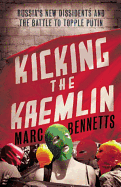
Kicking the Kremlin: Russia's New Dissidents and the Battle to Topple Putin

Marc Bennetts (Get this book)
Engagingly grim, frequently absurdist portrait of Vladimir Putin and the popular protests against him, which are gaining steam. Moscow-based British journalist Bennetts maintains a cool, even tone throughout these portraits of the Putin oligarchs, who are determined to keep power, and the leaders of the dissident movements aiming to oust them. Bennetts insightfully portrays a Russia on the cusp of popular revolt.--Kirkus

Wednesday, February 26, 2014

The Muslims Are Coming!: Islamophobia, Extremism, and the Domestic War on Terror -

Find This Book

"A widely researched argument about why the war on terror will have no success unless the West stops blaming Islam and starts locating the roots of political dissent. In fighting the war on terror, Kundnani (Terrorism Studies/John Jay Coll.; The End of Tolerance: Racism in 21st Century Britain, 2007) sees the governments of the U.S. and Britain as employing the same wrongheaded surveillance tactics that were created by the Russians and sharpened by the CIA, then the FBI, in cracking down on dissidents during the Cold War and the civil rights era. The problem, writes the author, is that Muslims have become an "ideal enemy," perceived by mainstream American and British societies as unable to assimilate properly due to the essential flaw in their religion: the inability to separate church and state. Policymakers view extremism as a "perversion of Islam's message," the twisting of what is essentially a benign religion into "an antimodern, totalitarian, political ideology." The truth is that most people are peace-loving and assimilationist, and Muslim communities have become a kind of "Asian model minority." Yet some of the youth, thwarted in their political expression, lash out in extremism--e.g., in the reaction to the wars in Iraq and Afghanistan and the plight of the Palestinians against Israeli aggression. In the crackdown on anti-extremism, scholars of "radicalization"--i.e., the process by which Muslims move toward terrorism--zero in on a spurious "cultural-psychological predisposition" toward violence and disaffection that offers intelligence and law enforcement agencies a framework to work with but does not address what Kundnani believes is at the root of the unrest: poverty and oppression. His examples of the pernicious reach of many policing tools are useful, such as the Prevent model launched in Britain in 2004, provoking questions about privacy and discrimination. Kundnani frankly and refreshingly moves away from ideological symptoms and toward political causes in tackling extremism."  (Kirkus Reviews)

Thursday, February 20, 2014

Inferno: An Anatomy of American Punishment

Find This Book

"An eye-opening report about how the United States, with just 5 percent of the world's population, holds 25 percent of the world's incarcerated population. Ferguson (Law, Literature and Criticism/Columbia University; Alone in America: The Stories that Really Matter, 2013, etc.) charges that American prisons have "become an evil for all concerned." Federal, state and local governments spend $80 billion per year on a system that provides jobs for one out of nine state employees. In order to promote the system's growth, private prison companies, as well as the unions representing guards, have become a self-serving lobby wielding their clout over political decision-makers. As one example, Louisiana's privatized, for-profit system holds one out of every 86 of the state's citizens: three times more than in Iran, seven times more than in China and 10 times more than in Germany. The numbers jailed and the severity of the sentences-- including life without parole for nonviolent crimes--are no longer comparable to any of the countries that are peers and allies of the U.S. Overcrowding risks unrest, and financial costs have outgrown available revenue. Ultimately, writes Ferguson, U.S. prison policy has reached a breaking point. The author puts much of the blame on the politicians whose legislation brought about this state of affairs, and he calls their political desires "the punitive impulse in American society." He wants to know whether it is reversible, noting that it's "simply a fact that voters promote to high office those politicians who want tougher penalties." Ferguson dates the origins of this current, nearly intractable situation to a knee-jerk response to widespread urban riots 50 years ago. An important wake-up call about an emerging crisis that threatens to become a human rights scandal of global proportions."(Kirkus Reviews)

Windfall: The Booming Business of Global Warming

Find This Book

"For most of the planet, the specter of global warming is ominous, but as journalist Funk reveals in this startling book, there are those who view the Earth's dangerous meltdown as a golden opportunity. Funk, who for traveled six years studying climate change, saw beyond the ecological disaster, profiling individuals and companies with an ambitious goal of turning a profit from a distressed planet one overwhelmed by carbon emissions at higher concentrations than at any time in the last 800,000 years. In alarming terms, he lists three major categories of global warming that need very little explanation the melt, the drought, and the deluge all of which have nations and citizens jockeying for position to cash in on the world's dwindling resources. Everybody is in the mix, according to Funk, from the Greenland secessionists betting on oil to set them free, Israeli wizards creating snows for barren ski slopes, South Sudanese warlords controlling precious farmland in a deal with fund managers, California firefighters teaming with insurance companies as the last barrier against wildfires, and a Dutch engineering firm's water-management ideas for securing a storm-ravaged New York City. Still, Funk's original, forthright take on the little-discussed profit-taking trend in the climate change sweepstakes is very unsettling."   (Publishers Weekly)